We are often viewed as a profession of doing. Clients come to us so we can apply something—techniques, mobilizations, pressures, stretches. They’re often hoping we will create less pain, more ease, more freedom of movement. And in our eagerness to help, many of us chase the next technique, the next “magical” approach, as if mastery were only a matter of adding more tools to our hands.
But what if, in a world that constantly pulls us outward, the most transformative act we can offer is not doing, but listening?
The Many Forms of Listening
Listening begins long before our hands make contact, starting in the intake, when we offer our full mindfulness and awareness to the person in front of us—not just hearing their words but sensing the nonverbal cues that shape the moment.
As massage therapists, we stay within our scope: we don’t interpret or treat emotions, but we do pay attention to shifts in breath, muscle tone and presence. This work is listening with presence, and the therapeutic relationship we build with our clients starts here.
Then, there is listening with the heart—a quiet, compassionate attunement that allows us to perceive the subtleties of another nervous system. Research in interpersonal neurobiology shows that humans coregulate through nonverbal cues, breath rhythms and microexpressions.1 When we listen with the heart, we become a safe relational field where the client’s physiology can soften.
For me, this field begins with the environment itself—warm light, an uncluttered room and no overwhelming scents to help the nervous system settle. I also pay attention to how I enter the interaction: greeting clients with a steady voice, a soft gaze and a genuine smile as my attention shifts fully toward them in a nonjudgmental manner.
If my mind is rushed, their tissues will stay guarded; but when I’m grounded, present and loving, their system begins to ease on its own. Nothing technique driven has happened yet, but a safe relational field is already setting the foundation for the work ahead.
And finally, there is listening with the hands.
The tissues speak in their own language—tone, temperature, resistance, yielding. Fascia, muscles and joints offer information if we approach them with curiosity rather than an agenda. This is not mystical; it is the nervous system responding to gentle, attuned touch.
Our hands are not just tools. They are sensory organs capable of perceiving stories the body has not yet put into words.
The Therapist as a Regulated Presence
To listen deeply, we must be grounded and centered ourselves.
Polyvagal theory reminds us that the nervous system is always scanning for cues of safety or threat. When we enter the room dysregulated, hurried or overly effortful, the client’s system feels it. But when we embody steadiness—when our breath is calm, our attention anchored, our presence coherent—we become a compass for what regulation feels like.
In that state, our touch communicates something techniques alone cannot: You are safe. You can soften.
Some of my trainings with the osteopathic community in my native France emphasized the importance of être au neutre—being in neutral. Neutral is not passive; it is a state of receptive clarity, a shift from doing to listening so the body’s inherent intelligence can express itself.
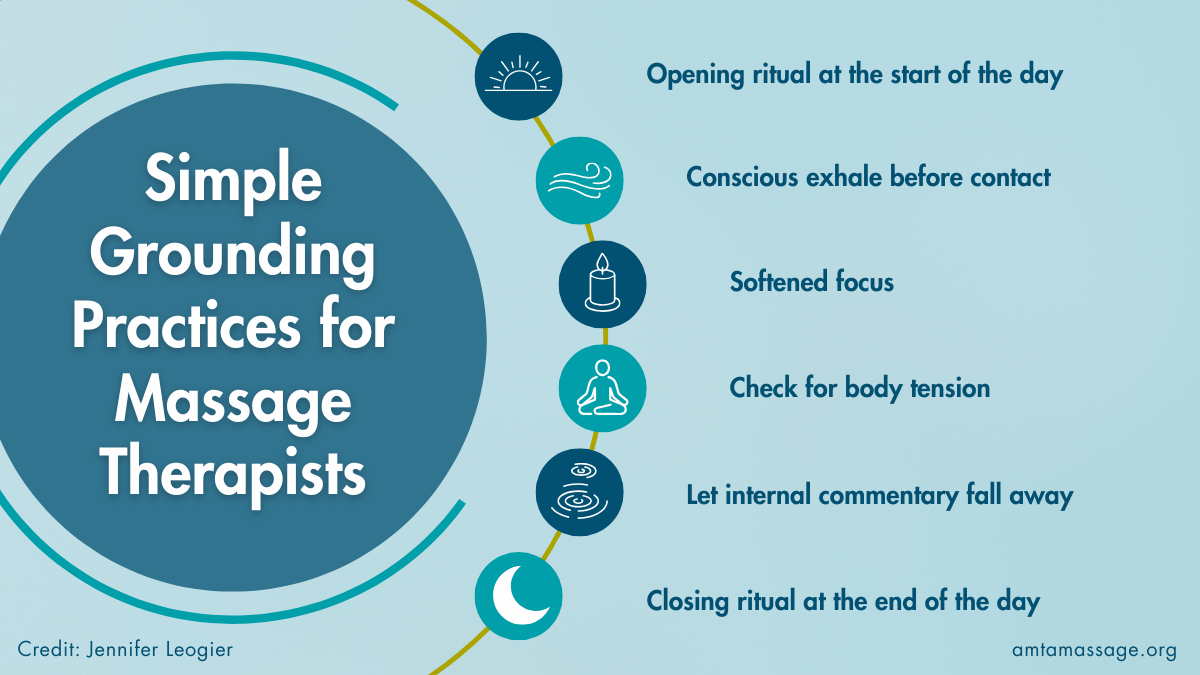
I access this state through simple grounding practices: an opening ritual before my first client, a conscious exhale before contact, softening my focus, checking where my own body holds tension, letting internal commentary fall away and a closing ritual at the end of each day.
In neutral, I’m not bracing, pushing or absorbing; my system stays regulated, which protects me from overuse, emotional entanglement and burnout. But above all, in neutral, I am not imposing change—I am witnessing it unfold, and there is a rare beauty in that.
Massage as a Dialogue Between Nervous Systems
Massage is not merely “I know techniques” and “you receive them.”
It is a communication between two nervous systems. When we are attentive enough, subtle languages emerge—changes in breath, shifts in tone, microreleases, emotional tremors, moments of stillness. These are not accidents; they are the body reorganizing itself in response to being met, not managed.
Science increasingly supports what many therapists have felt intuitively: attuned touch modulates pain perception, reduces sympathetic arousal, enhances interoceptive awareness and supports neuroplastic change.2 But beyond the data, there is something profoundly human about two people sharing a moment of quiet presence in a noisy world.
Returning to the Essence
Perhaps the future of our profession is not in accumulating more techniques but in refining our capacity to listen. Techniques matter— they reflect our training, our anatomical understanding and our manual skills. Yet it’s when those skills meet true listening that they become something more: a therapeutic space where the body feels safe enough to shift.
When we listen with our minds, our hearts and our hands, we honor the body’s wisdom. We create space for change rather than forcing it. We become facilitators of new possibilities rather than fixers of problems.
In praise of listening, we return to the essence of touch: a meeting of two beings, each influencing the other, each capable of healing in the presence of genuine attention.