Continuing Education
A Deeper Understanding of Pain
Learn more about how you understand and ultimately help clients who struggle with pain.
Precision neuromuscular therapy places a heavy reliance on creativity to help massage therapists solve their clients’ problems.
November 1, 2025

Perhaps the best way to describe what Precision Neuromuscular Therapy (PNMT) is, is to first describe what it’s not. PNMT is not a technique or modality within the massage therapy space. Instead, it is a way of thinking and a framework for effective soft-tissue therapy.
PNMT teaches therapists how to be creative problem solvers when their preferred method for working on soft-tissue dysfunction does not adequately address the client's needs.
“We teach therapists how to review a multitude of possible neuromuscular reasons for any clinical complaint presented by the client, then how to reason through the possible suspects without necessarily treating each one, which would be very inefficient,” says Douglas Nelson, founder of Precision Neuromuscular Therapy. “Each possible explanation might require a very different treatment approach, and the wisdom is in the choosing of which one and, most importantly, why. When plan A fails, and more often than not it does, therapists need multiple possible strategies.”
This homing in on the neuromuscular reasons for a complaint is what gives PNMT its precision and provides therapists the ability to narrow down any possible sources of pain or discomfort. They can target those areas to achieve the best results using the best-suited techniques for a client.
As Sarah Lashley, owner and director of Somavida Pain Relief Center and PNMT Clinic puts it: “PNMT is defined by creative problem-solving skills, not by adherence to a singular approach.”
PNMT is different from neuromuscular therapy because neuromuscular therapy is often viewed as primarily trigger-point focused with an emphasis on structural symmetry. Nelson notes that while both of these are components of PNMT, PNMT also looks at other possible causes of dysfunction.
“PNMT differs from traditional neuromuscular therapy and deep tissue massage in that when we see a postural asymmetry, first we ask is this a defense or a defect? We don’t just assume everything is a defect that needs to be fixed,” says Lashley. “We have assessments to help us investigate if this is a nerve issue, muscle issue, fascial issue or a combination of these. Then we approach the issue with our wide range of tools.”
Nelson also points out that PNMT is much less physically demanding than much of deep tissue work. Because PNMT by its nature is hyper-precise, the amount of force needed to engage the area being worked is much less than is required in deep tissue or other massage therapy approaches.
The amount of pressure used in PNMT is not a one-size-fits-all approach. Instead, Nelson likens it to volume in music. “There is a time for intensity and a time for softness,” he says. The time for intensity or the time for softness is determined by asking the client direct questions during the session, including:
These questions allow the client to choose the approach and dictate the amount of pressure being used. Nelson finds it important to note, however, that when a therapist finds themselves in exactly the right spot, no one ever asks for more pressure. “I tell my students that when a client states, ‘Well, maybe if you pressed harder,’ that is code for ‘you are in the wrong place.’”
Instead of relying solely on pressure, Nelson encourages students to alter their own position and/or the client’s position, or change the angle or direction of the pressure. All of these options are preferable to simply using more pressure.
Additionally, Lashley points out that PNMT is often done with clients fully clothed, which allows the therapist to perform range of motion and orthopedic assessments during the session so they know what’s working and what’s not. These assessments, along with client feedback, help massage therapists know when to pivot during the session instead of waiting until the end to evaluate success.
“What PNMT does best is address a multitude of musculoskeletal issues that fall through the cracks of our current health care system. For many conditions, once the cause is ascribed to soft-tissue, patients are often told that it is good that it isn’t something more serious and the symptoms should resolve on their own over time,” Nelson explains. “Being told that these symptoms will likely resolve in several months isn’t very comforting if you are a person in pain.”
Clients who have turned to PNMT often present with issues that cannot be identified via more traditional diagnostic tools like MRIs, x-rays or CT scans. With no reliable diagnosis, people often feel invalidated by their health care providers and sometimes even by friends and family members.
“Many clients have shed tears of relief when I was able to recreate their symptoms with highly focused touch,” Nelson says. “Having their symptoms recreated validates that yes, something does explain why they feel what they feel. This also gives them hope that something can be done, as well.”
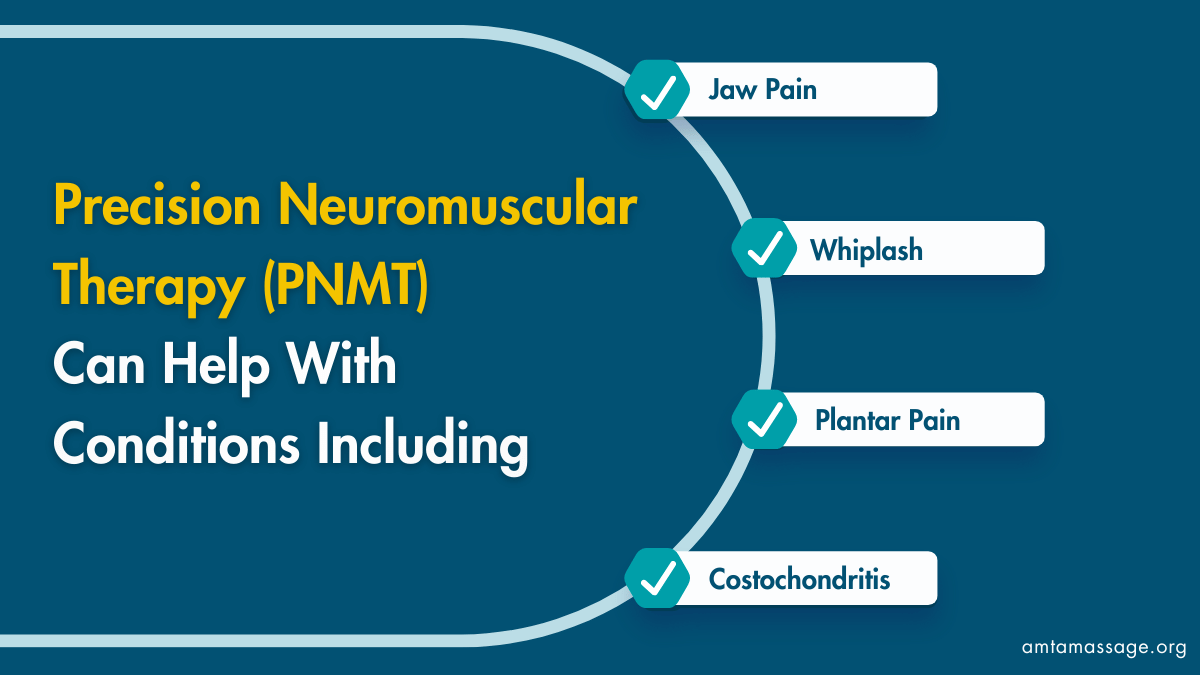
Nelson notes four examples that come to mind:
The reason PNMT can specifically help with each of these issues, according to Nelson, is because what is often neglected in these four conditions is thoughtful, thorough, careful and precise soft-tissue therapy that can speed the process of recovery dramatically.
“Overall, the main benefits of PNMT are pain relief, increased mobility, and reduction in pain and dysfunction in clients, allowing them to get back to doing what they love to do,” Lashley says.
What PNMT does best is address a multitude of musculoskeletal issues that fall through the cracks of our current health care system.
Douglas Nelson
Although there are similarities to traditional massage sessions, like doing a thorough intake and getting feedback during a session, PNMT depends on clients being active participants in helping massage therapists pinpoint the issue, and that can feel different for some people.
The assessment process may be more in-depth, too. Before a session, range of motion is measured, and a series of movements and orthopedic tests investigate what structures may be the source of their pain.
The client’s role in the process does not end when the massage session begins because their feedback continues to play an important role in the direction the session takes.
“During the treatment, clients will be actively engaged as the therapist works on the suspected tissues found in the testing,” Lashley says. “Client feedback is crucial in helping us know the exact problem areas.”
Nelson also remarks on the importance of the client’s role in a session, “I often tell clients, ‘I know what I feel in my hands but I do not know what you experience. I need your feedback.’”
Reassessing a problem during the session is also important. If a client presents with restricted range of motion, clients need to recreate the motion throughout the session to see if progress is being made.
“Doing this solely at the end of the session makes no sense, especially if the results are less than impressive,” Nelson says. “If what I am doing isn’t working, I want to know as soon as possible so I can change strategies.”
When considering if PNMT is right for them, clients should remember the work is specific and focused on their presenting symptom or symptoms. For example, if a client comes to the session saying they have neck discomfort with limited rotation, the entirety of the session will be geared toward achieving the goal of greater range with less pain.
Every therapeutic action should have a clear “why” behind the “what” and be directed toward achieving the client’s desired outcome.
According to Nelson, it is important to remember that specificity and duration are inversely related, however. “The more focused the work, the shorter the duration of the sessions,” he says. “Over the years, we have found that for many conditions, shorter sessions done more often are far more effective than longer sessions done infrequently.”
In many ways, PNMT is a mindset: A targeted, creative way of exploring the many problems massage therapists are faced with on a daily basis to find the best solutions for their clients.
“PNMT is a great approach to manual therapy to truly understand the complexities of soft tissue pain,” Lashley says. “Its approach is aimed to give you the skills and confidence to create a wonderful, fulfilling and successful practice.”
In many ways, PNMT is a mindset: A targeted, creative way of exploring the many problems massage therapists are faced with on a daily basis to find the best solutions for their clients.
As Nelson explains, PNMT is born from decades of clinical experience. This clinical experience finds massage therapists facing the challenges presented by clients’ muscular problems every day. These challenges, however, also present a great learning opportunity for the massage therapists—if they know how to properly approach the problem.
“We hope to provide therapists with an array of assessment and treatment approaches from which to draw upon. In this way, we help them build their competence and confidence as they transition from technician to clinical artistry,” says Nelson. “Real confidence isn’t knowing the answer, it is knowing how to approach the problem.” It is this exact idea that PNMT attempts to instill in the massage therapists who practice it.
Clients who have turned to PNMT often present with issues that cannot be identified via more traditional diagnostic tools like MRIs, x-rays or CT scans.
With no reliable diagnosis, people often feel invalidated. The client's role in the process does not end when the massage begins because their feedback continues to play an important role in the direction the session takes.
A Deeper Understanding of Pain
Learn more about how you understand and ultimately help clients who struggle with pain.
Looking at Pain More Holistically
Pain is more than a physical experience. Learn how taking a more whole-person approach may help you help your clients better manage their pain.