Massage Therapy Journal
Get Better Sleep With Aromatherapy
What some recent research is saying about aromatherapy and sleep quality.
The benefits of massage for sleep go beyond relaxation.
by David Malone, February 1, 2026
It is no secret that sleep is an important component of a healthy lifestyle. However, quality sleep is not always easy to come by.
“Sleep is one of the three pillars of a healthy lifestyle,” says Dr. Nitun Verma, American Academy of Sleep Medicine (AASM) spokesperson. “The American Academy of Sleep Medicine recommends adults obtain seven or more hours of sleep regularly for optimal health.”
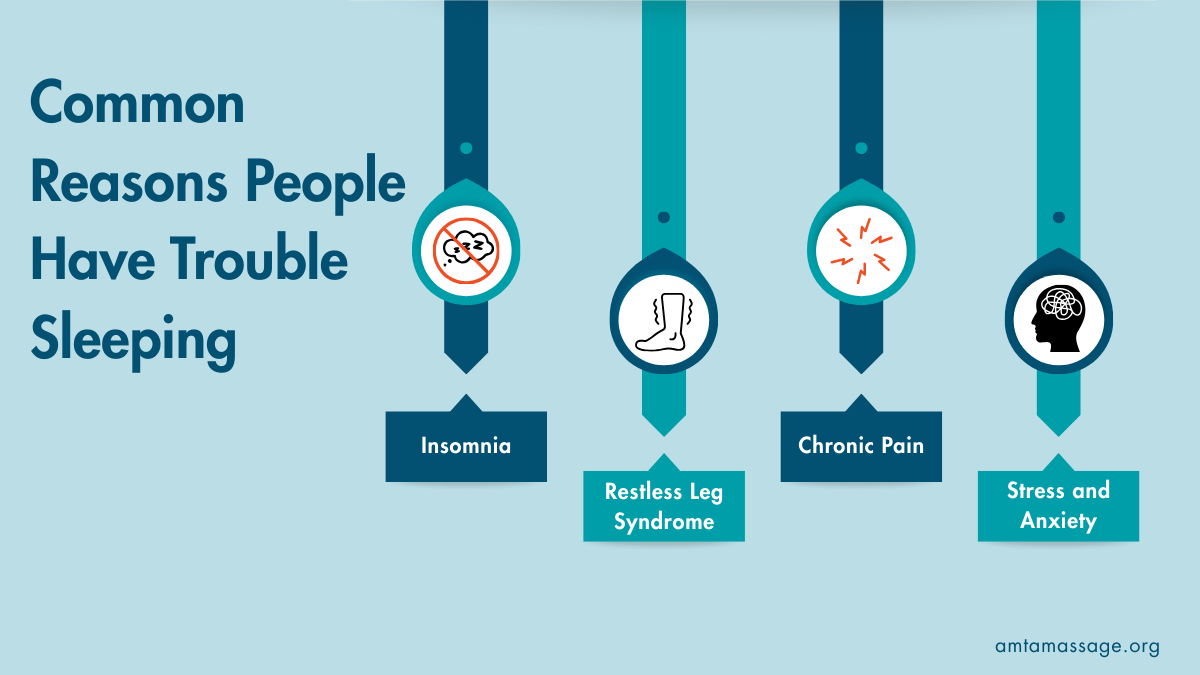
Insomnia, restless leg syndrome, chronic pain and stress and anxiety are common reasons people have trouble getting the recommended seven hours of sleep, but initial research shows massage therapy may be a strong non-pharmacological option for improving sleep.
“Massage is an excellent holistic tool for improving sleep quality because it helps resolve three major sleep disruptors: pain, stress and anxiety,” says Rebekah S. Delling, LMBT and sleep coach/educator.
The timing of a massage and the techniques used could affect the quality of the benefits. While any massage at any time could help improve sleep, slower, more relaxing massages later in the day could amplify the benefits.
“It’s my personal philosophy that all massage can improve sleep at some level,” says Delling. “But there are some specific techniques that facilitate deeper, more serene sleep. While I recommend neuromuscular and trigger point massage for pain management, for sleep, I find gentler and more soothing techniques like effleurage, rocking and shiatsu to be the most effective. A full body holistic approach to massage will promote sleep quality, as will manipulating the pressure points in the ears, hands and feet that directly promote sleep and relaxation.”
Additionally, self-massage is a great way to extend the benefits of a regular massage session prior to going to bed. Tools such as massage guns, cork balls, a massage star or a Thera cane can help ease muscle pain before bed to improve sleep. “I teach my sleep clients gently rocking the body whilst sitting on the side of the bed and using tapping or other complementary techniques,” says Delling.
As far as timing goes, the closer to bed, the better, as long as the massage is not too stimulating. “While definitive research is limited, studies examining the relationship between massage therapy and sleep typically administer the treatment within 1–2 hours before bedtime,” Verma says. “This timing aligns with general sleep hygiene recommendations to engage in relaxing activities during the hour before sleep. Massage therapy can, in fact, be a part of a nightly wind down routine as a part of a daily sleep hygiene plan.”
Delling has also seen firsthand how massage later in the day can help with sleep. “Many of my clients report that they get better quality sleep for up to a week after receiving a massage later in the day,” she says.
For sleep, I find gentler and more soothing massage techniques like effleurage, rocking and shiatsu to be the most effective.
Rebekah S. Delling, LMBT
Much of the research for massage therapy’s effect on sleep, especially in relation to specific sleep disorders, remains preliminary. However, the evidence that does exist shows some benefits.
For example, a systematic review and meta-analysis1 explored the effect of massage therapy on sleep quality in critically ill patients. The systematic review examined 10 randomized controlled trials that comprised 569 participants. The meta-analysis included eight trials.
The Cochrane risk of bias tool for randomized trials was used to assess the risk of bias and the Grading of Recommendations Assessment, Development and Evaluation system assessed the certainty of evidence and recommendations.
The results of the review and analysis found significant effects of foot reflexology massage on subjective sleep quality. Meanwhile, massage therapy for a two-night duration in cardiac care unit patients exhibited a significant effect on subjective sleep quality.
Researchers concluded that massage interventions provide a non-invasive, low-cost and effective way to promote sleep quality in critically ill adult patients.
According to a survey conducted by the AASM, 12% of Americans said they have been diagnosed with chronic insomnia, which involves difficulty falling asleep or staying asleep or regularly waking up earlier than desired. This can lead to daytime fatigue or sleepiness, trouble concentrating, depression, anxiety, and low motivation or energy.
Some evidence suggests massage therapy can help individuals suffering from insomnia. A study2 examined the impact of massage prior to bedtime on both sleep quality and quantity in people with chronic insomnia.
The study included 20 individuals with an Athens Insomnia Scale score of ≥16. The individuals participated in three different settings one week apart that included a 45-minute relaxation massage, a 45-minute sham massage setting and a control setting with no massage. Sleep activity was then monitored using a portable polysomnographic system.
The results showed a statistically significant effect between sleep efficiency across the three sessions with a notable effect in the relaxation massage session. Researchers concluded that relaxation massage prior to bedtime could be used as an effective and safe non-pharmacological approach for improving sleep efficiency and potentially restoring the fragmented sleep of individuals with symptoms of insomnia.
Restless leg syndrome (RLS), according to the Mayo Clinic, is a condition that causes a strong urge to move the legs that is usually caused by an uncomfortable feeling. The condition typically flares at night when sitting or lying down, and can lead to sleep issues.
A meta-analysis3 of five randomized controlled trials explored the clinical efficacy and safety of massage for hemodialysis patients with RLS. In total, 369 hemodialysis patients with RLS were analyzed.
In the studies, the RLS score after treatment and the mean difference of the RLS score at the beginning and end of treatment in the massage groups was significantly better than that in the routine care groups. Subgroup analysis also suggested that massage with lavender oil significantly reduced the RLS score after treatment and mean difference of RLS score at the beginning and end of treatment compared with routine care.
The meta-analysis concluded that massage may be a preferred treatment modality for hemodialysis patients with RLS because it effectively reduces RLS symptoms, relieves RLS severity and does not increase the risk of adverse effects.
“Massage therapy for people with restless legs can be helpful, and in some cases is a first line option before considering medications,” says Verma. “However, more research is necessary.”
It’s true, massage therapy can make people feel more relaxed which can, in turn, help with sleep. But studies show it goes beyond relaxation and can actually lead to changes in the brain.
A study4 examined the effects of parent-led massage and sleep EEG for term-born infants. In total, 182 newborn infants were split into intervention (routine parent-led massage) and control groups.
Infants had a daytime sleep EEG at four months and were assessed using the Griffiths Scales of Child Development at four and 18 months. Additionally, comparative analysis between groups and subgroup analysis between regularly massaged and never-massaged infants were performed. The groups were compared for sleep stage, sleep spindles, quantitative EEG (primary analysis) and Griffiths using the Mann-Whitney U test.
Despite the study not observing a difference between the two groups in nap duration or first cycle macrostructure, interesting changes in the brain itself were observed. The study found that routine massage of infants is associated with differences in sleep electroencephalogram biomarkers at four months.
Massaged infants were found to have had higher sleep spindle spectral power (characterized by bursts of brainwave activity), greater sleep EEG magnitudes and lower interhemispheric coherence (measurement between the left and right hemispheres of the brain).
So what does all of this mean? In short, routine massage may be associated with distinct functional sleep-associated brain changes at four months.
Massage has also shown to impact hormone levels. “During a massage, the stress hormone cortisol decreases and the happy hormones serotonin, ocytocin and dopamine increase,” says Delling.
A study5 looked at the holistic effect of complementary interventions (including massage therapy and aromatherapy) in reducing stress in college students. As part of the study, salivary cortisol levels were measured before the complementary therapies and after and found they were significantly reduced from pre-session to post-session, demonstrating “… that brief complementary interventions can alter students’ holistic health perspectives, with objective physiological data confirming changes that promote health and well-being,” according to the study.
Initial research suggests massage therapy is a good non-pharmacological tool to help individuals, both those suffering from sleep issues, as well as those who are just interested in an improved sleep hygiene routine, get better quality sleep.
While further research on a larger scale is necessary, initial research suggests massage therapy is a good non-pharmacological tool to help individuals, both those suffering from sleep issues, as well as those who are just interested in an improved sleep hygiene routine, get better quality sleep.
While relaxation techniques like massage therapy may help some individuals as part of a comprehensive sleep hygiene approach, persistent sleep problems warrant professional evaluation by a doctor.
1. Fang CS, Chang SL, Fang CJ, Chou FH. “Effect of massage therapy on sleep quality in critically ill patients: A systematic review and meta-analysis.” J Clin Nurs. 2023 Aug.
2. F, Pappas A, Dardiotis E, Sakkas GK. “The Impact of Relaxation Massage Prior to Bedtime on Sleep Quality and Quantity in People with Symptoms of Chronic Insomnia: A Home-Based Sleep Study.” Healthcare (Basel). 2025 Jan 17.
3. Xia M, He Q, Ying G, Fei X, Zhou W, He X. “Clinical Efficacy and Safety of Massage for the Treatment of Restless Leg Syndrome in Hemodialysis Patients: A Meta-Analysis of 5 Randomized Controlled Trials.” Front Psychiatry. 2022 April.
4. Ventura S, Mathieson SR, O’Sullivan MP, O’Toole JM, Livingstone V, Pressler RM, Dempsey EM, Murray DM, Boylan GB. “Parent-led massage and sleep EEG for term-born infants: A randomized controlled parallel-group study.” Dev Med Child Neurol. 2023 Oct.
5. Cefo L, Navarre K, Chicoski A, Wilhite M, Cox V, Feeney S. “The Holistic Effect of Complementary Interventions in Reducing Stress in College Students.” J Holist Nurs. 2025 Jan 19.