Continuing Education
AMTA Sports Massage CE
Explore how sports massage can reduce muscle tension, enhance athletic performance, and help prevent injuries.
Now more than ever, massage therapy is situated to be an essential aspect of the recovery strategy for the tens of millions of people who play golf each year.
by Sam Kauffman, August 1, 2026
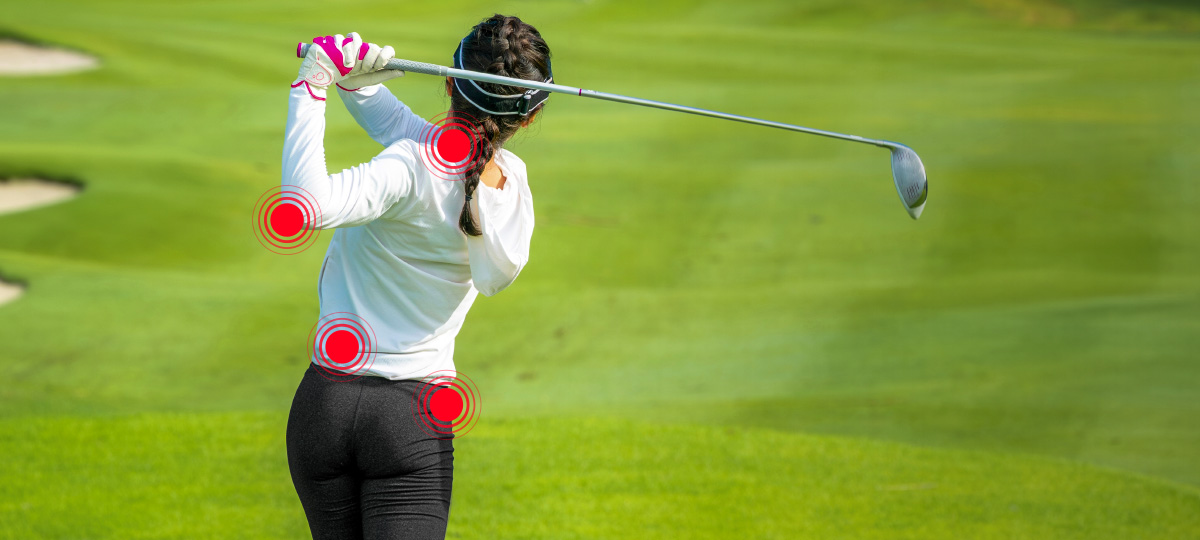
There’s an unmistakable stillness found in the game of golf. Sometimes the stillness appears as the sunbeams that stretch across the green during a sunrise tee time. Or the intentional pause right before the club makes contact with the ball at a driving range.
This slowing down is part of what attracts players and keeps them coming back year after year. Yet, as many eventually discover, golf is also a game of surprising physical demand. To the casual observer, golf might seem like a leisurely stroll through manicured landscapes punctuated by the occasional swing.
Massage therapists, however, know a different story.
In your practices, you see the tight hip flexors, the overtaxed lumbar regions and the repetitive strain in the forearms that tell the tale of a sport that is as punishing as it is tranquil.
As massage therapists, you have a unique opportunity to serve as essential partners in a golfer’s recovery. By understanding the common ailments golfers experience and techniques that can make a difference, you can be a part of their ongoing efforts to keep their swing fluid and their body pain-free.
While golf may not draw the same size crowds at sporting venues or local bars as football, basketball or baseball regularly do, it is much more commonly played.
In fact, in the last decade, its popularity has steadily grown—by about 40%—making it one of the most popular sports by participation. Last year, according to the National Golf Foundation, nearly 50 million Americans swung a golf club at a course or a driving range.
Part of this rise in players is that more women are participating. On any given day, you’ll find that about a third of players on a course are now women. Another reason is that there are more so-called “off-course” players who spend their time at driving ranges or golf simulators.
For massage therapists, these shifting demographics present new opportunities to serve clients, including those who are managing golf-related injuries and those who want to enhance their performance.
With more people taking up the game than ever before, the demand for understanding the physical strain of the swing has never been higher. This is because the golf swing generates the majority of golf-related injuries, which are escalating.
The golf swing is widely considered one of the most complex movements in sports, incorporating a full-body kinetic chain that begins at the feet and ends at the follow-through, requiring a delicate balance of explosive power and controlled stability. Involving almost every major muscle group, several dozen primary muscles and a total of over 200 muscles work together to perform the swing.
Because the swing is so complex, massage therapists who frequently work with golfers agree that physically observing a client’s swing can be a profound eye-opener. Tenured massage therapist and founder of Precision Neuromuscular Therapy (PNMT) Doug Nelson, whose practice is located in Champaign, IL, commonly works with golfers in the area. “You have to see, because your image of what [their swing] looks like and the reality of what that looks like can be wildly different things,” he explains.
During the swing, the body must rotate around a central axis while maintaining a stable base. This requires incredible coordination between the core, the glutes and the spine. If a golfer has restricted range of motion in their hips or shoulders, the body will naturally look for that mobility elsewhere—often forcing the low back to compensate.
Over 200 muscles work together to perform the golf swing.
Nelson describes this motion as a “complex symphony of movements,” and emphasizes that if a client’s body is physically restricted, they simply cannot execute a proper swing. “Soft tissue restraints create altered mechanics,” Nelson points out, meaning structural limits impact performance, not just dysfunctional technique.
In addition to treating symptoms of overuse or an imbalanced swing technique, many golfers desire faster swing speeds to improve the distance the ball travels. While optimizing the swing is a lifelong endeavor, research shows massage therapy can offer measurable benefits for swing speed, including better flexibility and muscle recovery.
In 2008, Nelson and his colleague James Ivaska ran a pilot study1 to find out how massage therapy affects thoracic range of motion and golf swing speed. They tracked baseline swing speeds and thoracic rotation among 51 amateur golfers.
Massage therapists delivered 15-minute neuromuscular treatments to the primary muscles of the torso. The payoff was substantial: average thoracic range of motion increased by 12.02 degrees and swing speeds jumped by 4.34 mph.
More recently, a 2020 systematic review2 of 29 studies from BMJ Open Sport & Exercise Medicine concluded that while massage therapy may not directly increase explosive sprint or jump power, its most significant contribution to athletes is the improvement of flexibility and the management of delayed-onset muscle soreness. For a golfer, flexibility is the difference between a restricted, choppy swing and a fluid, high-velocity one.
Research shows massage therapy can offer measurable benefits for swing speed, including better flexibility and muscle recovery.
Unlike contact sports, where injuries are often acute and traumatic, golf injuries are typically the result of cumulative micro-trauma. The repetitive nature of the swing, combined with the asymmetrical forces applied to the body, can lead to chronic imbalances that eventually manifest as pain.
Here are some of the most common injuries you might see when working with golfers:
The low back. Low back pain is one of the most common complaints among golfers, often stemming from the intense rotational forces placed on the lumbar spine. When the thoracic spine lacks mobility, the low back is forced to rotate beyond its intended range.
What’s more, unsurprisingly, golfers who carry their own bag experience twice the rate of injury in the low back and shoulders compared to golfers who do not carry a bag, according to the American Orthopaedic Society for Sports Medicine.
Massage therapy can help alleviate the persistent tightness in the deep muscles of the low back and along the spine.
The elbows. Medial epicondylitis, or “golfer’s elbow,” is another hallmark of the sport. This condition involves the inflammation of the tendons that attach to the medial epicondyle of the humerus and occurs on the right elbow for a right-handed golfer and left elbow for a left-handed golfer.
Medial epicondylitis is characterized by pain, tenderness, weakness or tingling at the inside of the elbow and is generally caused by overuse, holding the club too tightly or shoulder restrictions that result in compensation patterns in the forearms.
“The reason they’re having the pain is they’re trying to hit the ball with their arms instead of generating the force with their hips and their body,” Nelson says of clients he sees with this condition.
While many clients are traditionally treated with steroid injections, a 2018 randomized clinical trial3 exploring the use of massage for lateral epicondylitis suggests that deep friction massage can be more effective for long-term recovery.
In the trial, those who received deep friction massage combined with lidocaine reported significant improvements in pain scores, grip strength and functional ability at a six-month follow-up, outperforming those who received cortisone injections alone. “Deep friction massage is an effective treatment for lateral epicondylitis and can be used in patients who have failed other nonoperative treatments, including cortisone injection,” researchers noted.
To strategically address the condition, experienced practitioners look beyond local distress to map out systemic relationships. Nathan Fay, a Connecticut-based massage therapist who specializes in Myoskeletal Alignment Techniques (MAT), urges therapists to investigate deeper nerve and joint pathways, asking themselves during intake: “Is that elbow pain really a tendinosis or do I need to do a neurodynamic assessment for cubital tunnel syndrome?”
By widening the clinical scope beyond the immediate area of discomfort, you can achieve better results. “We really have the opportunity to look at the whole body to see how one system affects the next and so on,” Fay notes.
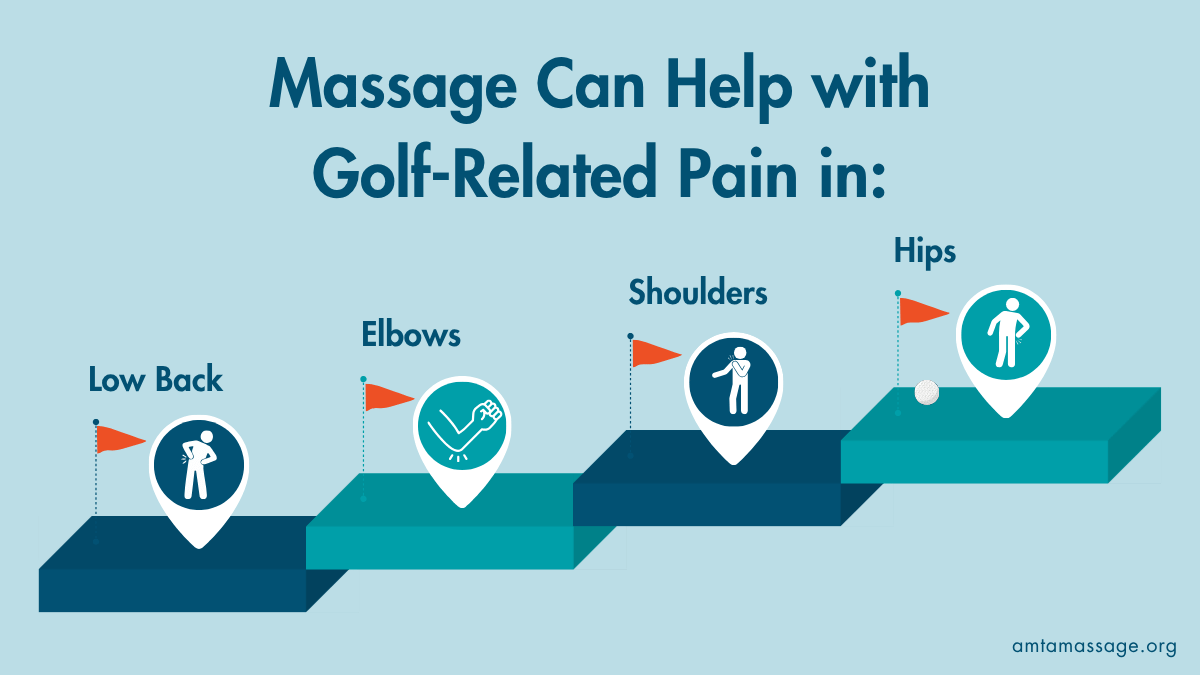
The shoulders. The shoulders are the primary engines of power in a golf swing, which makes them susceptible to overuse. The lead shoulder, which is the left shoulder for a right-handed golfer and vice versa, endures extreme horizontal adduction during the backswing—a movement that can place immense stress on the back of the shoulder joint and the small stabilizing muscles.
Over time, when shoulder muscles become tight, they can disrupt the mechanical balance of the joint, leading to impingements, bursitis or limited follow-through during the swing.
Ivaska, a PNMT practitioner based in Morrisville, PA, highlights that rotator cuff injuries are incredibly common in golfers, although the root issue is rarely isolated to the shoulders alone. “The underlying cause for those symptoms may be a bit more complex,” he explains. “Their inability to rotate their thoracic spine sufficiently for the golf swing may be the reason they have to move more at the shoulder, which creates issues.”
Nelson describes how a simple physical limitation in thoracic rotation completely unravels a player’s form: “I’m standing right now, looking at the floor, looking at the golf ball. If I rotate my shoulders, at some point my left shoulder is coming over my chin,” he says. “Well, if you can’t do that, and you want to rotate back to generate some force on the club … your head goes with your spine. Now you have taken your head away from the ball. Keeping your eye on the ball goes out the window, right? In an effort to try and do one thing, and you have limitations somewhere else, the whole thing falls apart.”
For golfers struggling with an overtaxed rotator cuff, massage therapy can make a notable impact. A 2025 randomized controlled trial4 tracked Swedish massage’s effects on upper-extremity mobility, localized pain and joint performance. The study revealed that participants receiving regular Swedish massage sessions over a three-week period experienced measurable reductions in both pain scores and shoulder dysfunction compared to the control group.
The hips. During the high-velocity follow-through, the lead hip must stabilize the entire body’s weight while rotating internally. Because of the forward-leaning posture of the swing and its one-sided nature, the hip flexors can become chronically shortened and tight.
The golf swing can also strain and restrict the hip rotators, which can cause pain and discomfort in the glutes, groin and low back. These muscle imbalances can significantly decrease swing speed.
Results from a 2023 randomized crossover trial5 show how a quick pre-round warm-up affects a golfer’s mechanics. The trial had participants perform self-myofascial release (using a foam roller) combined with static and dynamic stretching on their lead hip. By targeting the hip’s internal rotators, the researchers found that this targeted routine yielded improvements in both pelvic range of motion and overall clubhead speed.
“Working with golfers is so interesting because the sport is so technical,” Ivaska says. “Fine-tuning the body to elevate technique makes the work very rewarding.” Delivering real value to golf clients requires a holistic understanding of biomechanics, anatomy and being able to connect them in real-time during the session.
As Nelson points out, unlocking a golfer’s true potential requires scanning the entire kinetic chain. “It takes a deep understanding of the biomechanics of the swing, but we would have to go through multiple different parts,” he notes. “What is their cervical rotational capacity? What is their thoracic rotation like? What’s happening in the low back? What’s the range of motion of their hips? Then we have to look at those things to see if there’s a big restriction somewhere.”
To effectively address golfers’ complaints, confidence in your anatomy knowledge is key. This confidence is the bridge between a client’s vague complaint of stiffness and a session that brings relief and renewed functionality. While the entire body is engaged in a swing, a few key regions bear the brunt of the workload: the lumbar spine, the forearm flexors, the hip flexors and the rotator cuff.
Understanding the relationship between these muscle groups and a golfer’s specific issues can foster trust and drive repeated visits. For instance, when a client presents with low back pain, your ability to explain how restricted hip mobility or a tight thoracic spine is forcing the lumbar region to overcompensate builds immediate trust.
Fay asserts that this knowledge can sometimes be more revealing than simply where a client is experiencing pain. “When assessing foot and ankle movement through their swing, trunk and hip rotation, this can tell a much bigger story as opposed to ‘it hurts here so let’s work there,’” he says. “It might tell me that the thoracic spine is ‘locked up’ in the follow through.”
When structuring a treatment strategy based on your assessment, keep in mind that clinical effectiveness isn’t limited to a single approach. “There are many roads to Rome,” Ivaska notes. “As a PNMT practitioner, I combine quite a few manual therapy techniques, including trigger point work, fascial work, movement-based techniques and more. I tend to focus my choices not so much on the technique I use, but rather on the assessment and decision-making that precedes the technique.”
For Ivaska, that critical assessment means physically putting a club into the equation. “I absolutely have the clients demonstrate their swing,” he explains. “It’s paramount to understanding how they move and function to help with any pain or dysfunction. I am not a golfer, but I went and purchased a 7-iron to have in the clinic so my golfers can use it to demonstrate their swing.”
Fay also warns against the clinical trap of chasing localized symptoms, drawing from his functional biomechanical framework. “The most important thing is to listen to everyone’s story, watch for movements as they are talking with you, and listen for clues,” he says. “It’s easy for people to want us to do therapy where it hurts, but a bigger assessment is necessary as pain can be a liar.”
Fay utilizes clinical tools like Erik Dalton’s ART model—assessing for Asymmetry (such as an obvious pelvic tilt or slumped posture), Restriction of motion, and Tissue texture abnormalities—to look at the body as an interconnected system. “From an MAT perspective,” Fay notes, “the assessment becomes more about a functional biomechanical assessment, versus just doing therapy where it hurts.”
His advice to massage therapists who serve golfers? “Have a deep understanding of movement through the shoulders, thoracic spine, hips as well as the foot and ankle … and don’t chase pain!”
It is incredibly common for amateur golfers to assume that on-course struggles or recurring aches are simply the byproduct of poor training or inexperience.
“The number of injuries in golf is quite high, especially in amateur players,” Nelson explains. “And it’s easy to say, ‘Well, obviously poor swing mechanics are the reasons for injury.’ But the other part of that equation is that soft tissue restraints create altered mechanics.”
Nelson describes the issue as a chicken-and-egg dilemma: pre-existing, hidden physical restrictions are what alter and stall a client’s performance.
When a massage therapist uses targeted work to clear those restrictions, it can feel like magic to a passionate player. “It’s not just a visualization thing,” Nelson emphasizes. “It’s not a lack of understanding of what a follow-through is on your part. It’s saying you physiologically really struggle with that movement. If I use very precise treatment and enhance that movement, suddenly you can do the one thing that was limiting your ability to execute a follow-through with a golf swing. And for a therapist, how cool is that? That you can unlock the door that keeps people from doing something they love.”
Ultimately, supporting a golfer means viewing their immediate physical discomfort through a global, dynamic lens. “So, it is understanding their presenting symptoms in the greater context of the biomechanics of their swing,” Nelson concludes. “A limitation in one place may lead to discomfort in another because you’re making up the difference. The body’s always compensating to save itself as best as it can, but that’s not always going to lead to the best outcome.”
AMTA Sports Massage CE
Explore how sports massage can reduce muscle tension, enhance athletic performance, and help prevent injuries.
Sports Injury & Opioid Addication: How Massage Therapy Can Help
Massage therapy is rapidly becoming part of the wellness puzzle when it comes to working with people with sports injuries and potential opioid abuse.
1. Nelson D, Ivaska J. “The effect of massage therapy on thoracis range of motion and golf swing speed: a pilot study.” 2008.
2. Davis HL, Alabed S, James T, Chico A. “Effect of sports massage on performance and recover: a systematic review and meta-analysis.” BMJ Open Sport Exerc Med. 2020 May 7;6(1).
3. Yi R, Bratchenko W, Tan V. “Deep friction massage versus steroid injection in the treatment of lateral epicondylitis.” Hand. 2017 Feb 1;13(1):56—59.
4. Rostami Z, Forouzi M, Abdulghani M, Shahrbabaki P, Canillas-Dufau T, Dehghan M. “Swedish massage for shoulder function and postmastectomy pain syndrome: a randomized controlled trial.” BMJ Support Palliat Care. 2025 Dec 23;16(1):150—161.
5. Hamada Y, Akasaka K, Otsudo T, Sawada Y, Hattori H, Hasebe Y, Kikuchi Y, Hall T. “Immediate effects of foam roller and stretching to the lead hip on golfers swing: a randomized crossover trial.” Healthcare (Basel). 2023 Jul 11;11(14):2001.