Continuing Education
AMTA Sports Massage CE
Explore how sports massage can reduce muscle tension, enhance athletic performance, and help prevent injuries.
Just like traditional athletes, it is important for esport athletes to focus on their physical well-being to perform at their best.
by David Malone, November 1, 2026
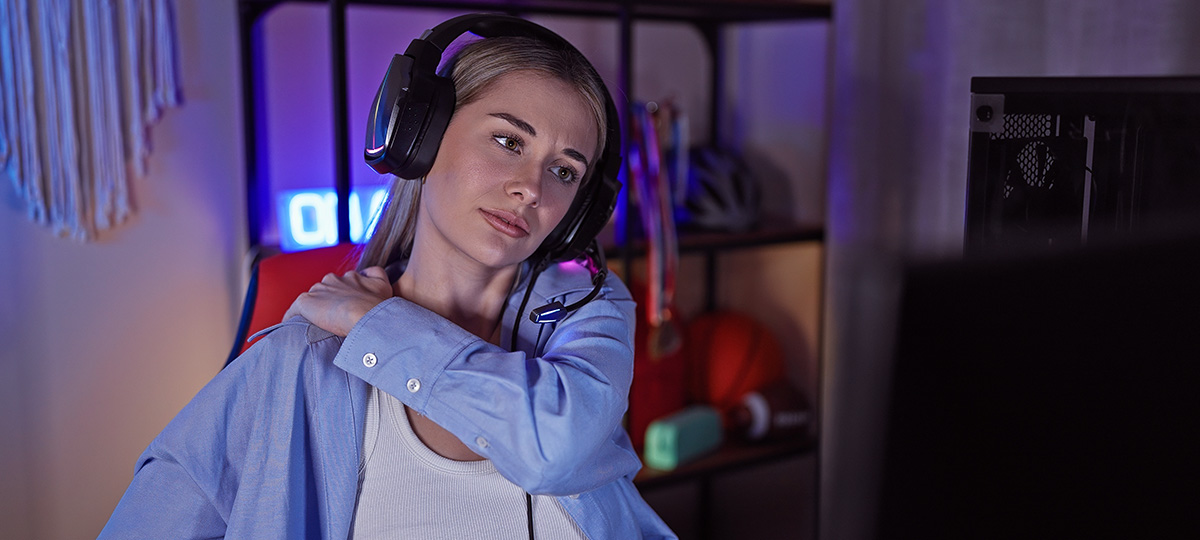
The days of gaming being isolated to kids (and some adults) heading to the local arcade with a pocket full of quarters and a few spare hours to kill are gone. Video games have not only become one of the most common hobbies across the country, but a multi-billion-dollar industry as well.
In its 2024 Essential Facts About the U.S. Video Game Industry report, the Entertainment Software Association estimates that 190.6 million Americans between the ages of 5 and 90 play video games. In 2023 alone, total consumer spending on video games reached $57 billion.
A subset of the video game industry—esports—has seen an equally meteoric rise in the past decade, dragging video games out of being purely a hobby and turning it into a profession. Esports are a form of competitive games played for both in-person and online spectators that pit players, either individuals or teams, against each other, often for a cash prize.
According to Statista, in 2024, the esports worldwide market reached a revenue of $4.3 billion and showed an annual growth rate of 6.59%, resulting in a projected market volume of $5.9 billion by 2029.
Many of these games require the athletes perform repetitive movements (such as clicking a mouse, controlling thumbsticks or pressing buttons) for long periods of time, which can lead to overuse injuries.
According to Esports Healthcare, some of the most common injuries in esports are:
Massage therapy can help prevent and alleviate the symptoms of many of these injuries.
While true that esports athletes do not deal with the same running, jumping and physical contact other athletes must manage, competitive gaming can still be a strenuous activity.
A 2024 study1 evaluated the influence of competitive video gaming on the perceived physical exertion and the perceived physical state (PEPS) of esports athletes. The study took 32 healthy male esports athletes and placed them in two competitive video game sessions lasting between 90 and 120 minutes, each interrupted by a 10-minute passive sitting break.
Repeated measures of perceived physical exertion (Borg Categorial Ratio-10 scale) and perceived physical state were recorded before, during and after each video game session.
The study found a significant difference in all dimensions of the PEPS and the Borg scale, suggesting the perceived physical burden significantly increases during esports participation. Additionally, the study noted that as the duration of the competitive video gaming extends, the perceived physical state decreases and perceived physical exertion increases. “Over time, and with a lack of observation, this could result in health and performance limitations,” researchers concluded.
Although massage therapy and its association with esports injuries (or the prevention of) has not been exclusively studied, the benefits massage therapy may provide people managing some of the most common esports injuries is solid.
Related: Download New Video Game-Themed Gift Certificate Template
For example, the benefits of massage for forearm, back and neck pain have been well documented. Massage has also shown to be helpful with some of the other common injuries associated with esports.
Conditions such as mouse elbow, mouse shoulder and medial epicondylosis are dysfunctions called tendinopathies. Tendinopathies make up the largest category of esports injuries according to Esports Healthcare.
One technique for a variety of tendinopathies that has shown benefit is deep friction massage. Deep friction massage, also known as cross friction massage, differs from Swedish massage in both the pressure used as well as in the direction of its application.
According to Physiopedia, deep friction massage “must be applied transversely to the specific tissue involved, unlike the superficial massage given in the longitudinal direction parallel to the vessels which enhances circulation and return of fluids.”
A systematic review2 assessed the efficacy of deep friction massage (DFM) in the treatment of tendinopathy. Nine studies were included, and researchers concluded after review that there is some evidence of “benefit at the elbow in combination with a Mills manipulation, as well as for supraspinatus tendinopathy in the presence of outlet impingement and along with joint mobilization.”
Additionally, the review suggested there is excellent anecdotal evidence along with a rationale for the use of DFM that fits the current understanding of tendinopathy.
Another study3 examined the effects of DFM as it relates specifically to the management of patellar tendinopathy in athletes. The study sought to assess whether the immediate effects of DFM on pain and muscle strength are dependent on the pressure applied.
The small study took 10 athletes with a diagnosis of unilateral patellar tendinopathy and provided them with three sessions of DFM applied with different pressures, as well as one control session. The study concluded that DFM induces an immediate reduction in pain intensity upon palpation, regardless of the pressure performed.
Sciatica is an experience of pain throughout the distribution of the sciatic nerve and can be a common cause for low back pain. Massage therapy has shown to help alleviate the symptoms associated with sciatica.
“Massage can be helpful for this problem, but there are some common guidelines you should consider,” says Whitney Lowe, LMT. “Back off on pressure. Generally, you should not use any technique that puts additional pressure on the sciatic nerve or its associated nerve roots. When massage therapists work with tight muscles, applying pressure with various massage techniques can decrease discomfort and improve pliability in those tissues. This idea does not hold true with nerve tissue, and massage therapists don’t want to do anything that puts further compression or tension on any of the affected neural structures.”
Because the term sciatica can be somewhat ambiguous, communicating with clients to best understand the origin of the pain to provide the greatest benefit is crucial.
More commonly known as De Quervain’s tenosynovitis, gamer’s thumb involves an inflammatory reaction between the tendon and the surrounding synovial sheath, and there may also be some degree of fibrosis, thickening or adhesion.
Generally speaking, this condition involves the abductor pollicis longus (APL) and extensor pollicis brevis (EPB), which are the two tendons on the radial side of the wrist.
Massage therapy may be helpful for this condition, and massage therapists should consider deep transverse friction performed directly on the APL and EPB tendons. Friction techniques may help reduce some degree of fibrous adhesion between the tendon and surrounding synovial sheath.
Additionally, deep stripping techniques and stripping techniques with active engagement applied to the forearm muscles may be helpful because the APL and EPB extend into the forearm, so a detailed and thorough treatment of the entire length of these tendons is helpful.
The benefits massage therapy may provide people managing some of the most common esports injuries is solid.
Many colleges and universities around the country are embracing the esports boom. Recent estimates show over 200 universities across the United States have official esports teams, with many offering partial (or sometimes even full) scholarships to their athletes.
In 2020, over $16 million in esports scholarships was awarded to students, according to Esport Scholar. This marked a significant increase from the previous year’s $8 million.
As the number of esports athletes continues to grow, so does the number of esports-related injuries. A survey4 was sent to 65 collegiate esport athletes from nine universities across the United States and Canada who all practiced between three and 10 hours a day. The survey asked about gaming and lifestyle habits, as well as musculoskeletal complaints due to esport competition.
The athletes surveyed reported the most common complaints as eye fatigue (56%), neck and back pain (42%), wrist pain (36%), and hand pain (32%). Interestingly, however, only two percent of the surveyed athletes sought medical attention for their pain and/or injuries.
The decision to not seek medical attention for any issues or injury is not solely a result of students not understanding the importance of maintaining their health, however. “As collegiate esports is growing, universities aren’t able to support physical therapy staff specifically for esports programs,” says Tj Bjorklund, League of Legends Head Coach at Illinois State University. “Depending on how money is allocated, accessing resources across campuses can be challenging.”
Currently, collegiate programs understand the physical side of esports, but a lack of funding means the majority of the responsibility for care falls directly on the athletes themselves. “We’ve provided our students with information regarding stretching techniques, but don’t have any mandates that they perform them. We do limit the number of hours that we ask of students and ensure that there are adequate breaks during any extended sessions to make sure that they have time to be healthy players,” Bjorklund says.
“We have training staff on campus that can work with the students as needed and have worked with the Cleveland Clinic for group sessions and training,” says Nate Meeker, Director of Esports, University of Akron. “Mostly, it is an exercise and stretching program that we encourage. However, keeping the injuries away in the first place with proper daily exercise is our main focus.”
Meeker also notes that while the program has not officially engaged with any massage therapists and there is not a massage therapist on staff, individual athletes have sought out individual care for an injury. Additionally, Meeker says a few of the athletes have used massage guns in the past to help with injuries.
This positions collegiate esports athletes as a demographic for massage therapists that is ripe with opportunity. Massage therapy’s benefits may be able to help esports athletes both recover from injuries as well as work as a preventive measure for some of the more common esports injuries.
As esports continues to grow in the future, training staffs like those seen with other traditional college sports will become more prevalent. “The physical aspect of gaming is important. We require our players to go to the gym on a weekly basis as a team and help to teach them about training,” Bjorklund says. “We know that we need to increase our involvement on the physical side, and look forward to working with university partners to increase access as we continue to get funding.”
If and when that funding increases, massage therapists should be ready to respond.
AMTA Sports Massage CE
Explore how sports massage can reduce muscle tension, enhance athletic performance, and help prevent injuries.
Sports Injury & Opioid Addication: How Massage Therapy Can Help
Massage therapy is rapidly becoming part of the wellness puzzle when it comes to working with people with sports injuries and potential opioid abuse.
1. Tholl C, Soffner M, Froböse I. “How strenuous is esports? Perceived physical exertion and physical state during competitive video gaming.” Front Sports Act Living. 2024 Jul 10;6.
2. Joseph MF, Taft K, Moskwa M, Denegar CR. “Deep friction massage to treat tendinopathy: a systematic review of a classic treatment in the face of a new paradigm of understanding.” J Sport Rehabil. 2012 Nov;21(4):343-53.
3. Chaves P, Simões D, Paço M, Silva S, Pinho F, Duarte JA, Ribeiro F. “Deep Friction Massage in the Management of Patellar Tendinopathy in Athletes: Short-Term Clinical Outcomes.” J Sport Rehabil. 2019 Sep 30;29(7):860-865.
4. DiFrancisco-Donoghue J, Balentine J, Schmidt G, Zwibel H. “Managing the health of the eSport athlete: an integrated health management model.” BMJ Open Sport Exerc Med. 2019 Jan 10;5(1).